
In school and family life, children and adolescents are continually called upon to respond, learn, follow instructions, adapt to adult schedules, and achieve objectives. They are immersed in days filled with stimuli, demands, and rapid transitions from one activity to another, while they have far less frequent opportunities to pause and calmly perceive what they are experiencing. For this reason, offering a space of listening, presence, and relationship can assume profound educational value, especially when it is not aimed at immediately obtaining a performance or a correct answer.
The circle in Educational Yoga arises precisely from this need. It is not merely a way of arranging children and adolescents in space, but a concrete form of relationship in which no one is placed in front and no one remains behind; each person can see the others and, at the same time, can feel seen. When the group gathers in a circle, the physical arrangement already communicates something: everyone occupies a place and that place has value, without needing to be won through competition or the ability to attract attention.
In yoga for children and adolescents, the circle can therefore become a fundamental element of practice, because it allows the gradual construction of a climate of trust, belonging, and mutual listening. It is a space in which the body can slow down, the breath can become more conscious, words can find their own time, and even silence can be recognized as a legitimate form of participation.
Table of Contents
The Circle as a Passage from Confusion to Presence
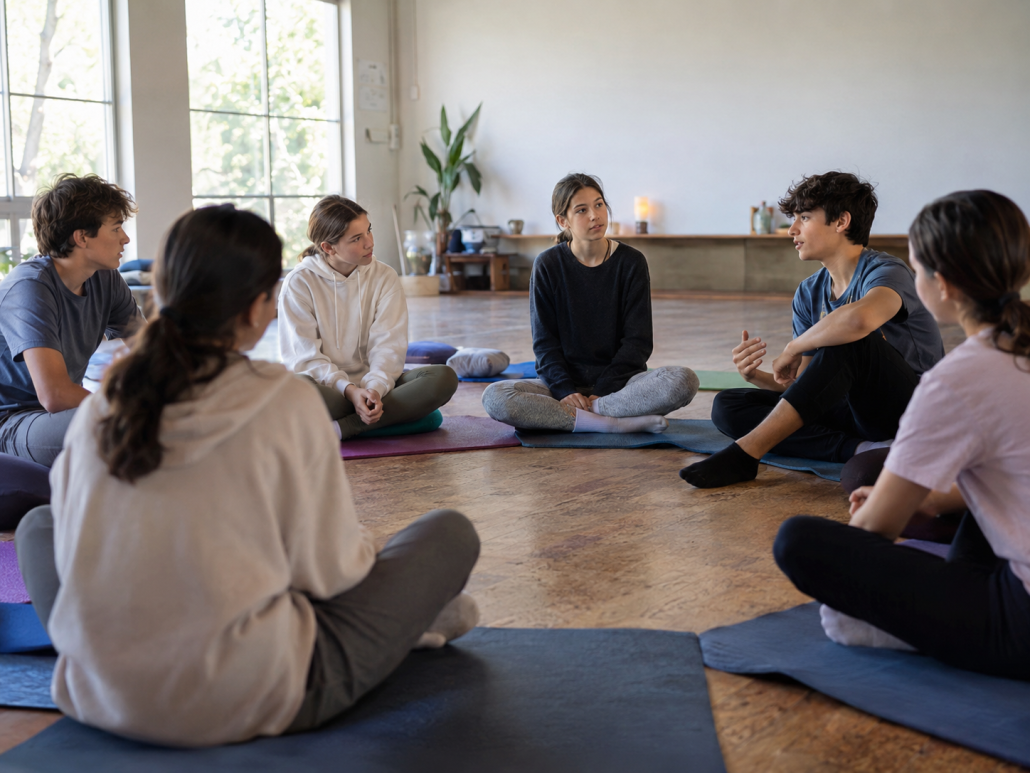
One of the most delicate aspects of education consists in accompanying children and adolescents through the numerous transitions that characterize their day. At school, there are constant shifts from recess to lesson, from movement to desk, from conversation to silence, from individual activity to group work. These changes often occur very rapidly, but the body and mind do not always manage to adapt with the same speed.
The circle in Educational Yoga can function as a bridge between what has just happened and what is about to begin. There is no need to immediately demand silence or perfect concentration; it is more important to create a condition in which the child can recognize that they are entering a different time, less oriented toward haste and more directed toward presence and listening.
For this reason, the opening circle should not be considered a simple organizational moment. It can become a true rite of passage, capable of gradually accompanying the group toward practice and allowing the educator or instructor to observe the real condition of the class. Each group, in fact, arrives with its own state: there are days when agitation prevails, others when children are tired, and still others when tensions, distraction, or little willingness to relate emerge.
Before proposing activities, games, breathing exercises, or postures, it is important to sense the “breath” of the group, because a truly educational practice does not begin from an abstract plan, but from an encounter with real people, in a specific moment, with different needs.
Listening to the Group Before Proposing
In education, there can be a strong temptation to intervene immediately: to explain, correct, organize, request attention. Yet, especially in work with children and adolescents, listening should precede intervention, because only by observing the condition of the group is it possible to choose consciously how to accompany it.
Many signals emerge in the circle. Posture, tone of voice, willingness to make eye contact, the way of being close to or distant from others, the need to speak, the difficulty in stopping, or the tendency to remain on the sidelines can offer valuable information. These signals should not be hastily interpreted as positive or negative behaviors, but can help the adult understand what the group is communicating.
A child who moves a great deal is not necessarily “disruptive”; they may need to release tension and movement before being able to concentrate. An adolescent who does not speak is not necessarily uninterested; they may need time to observe and feel sufficiently safe. Similarly, a noisy class is not always a difficult class to manage: it may be a group that has not yet found a way to transform its energy into shared attention.
In the educational circle, therefore, observation allows one to move beyond rigid categories and to meet the group in its reality. This attitude is particularly important in yoga in the classroom, where the effectiveness of the proposal also depends on the ability to adapt the timing, modalities, and intensity of the experience to the people who are present.
The Educational Value of Non-Judgment
One of the most valuable elements of the circle in Educational Yoga is the possibility of constructing a space in which children and adolescents can express themselves without feeling continuously evaluated. This does not mean eliminating rules, because a safe space requires clear and comprehensible boundaries. One listens to whoever is speaking, turns are respected, no one is mocked, no one is forced to share something, and words are not used to hurt.
Within these boundaries, however, an important freedom can open. The child can recount a sensation, express a thought, use a gesture, or choose to remain silent. Even silence, if not interpreted as opposition or lack of participation, can be an authentic mode of presence.
This aspect assumes particular value in school, where many activities are inevitably connected to evaluation, the correct answer, error, and assessment. The circle in yoga at school can offer a different experience, in which not everything that is said must be corrected and not every emotion must be immediately explained or interpreted.
At times, the most important educational experience consists simply in being heard. For many children and adolescents, feeling that their words can exist without being immediately judged represents a significant step in building trust in themselves and in relationships with others.
Circle and Class Group: Learning to Be Together
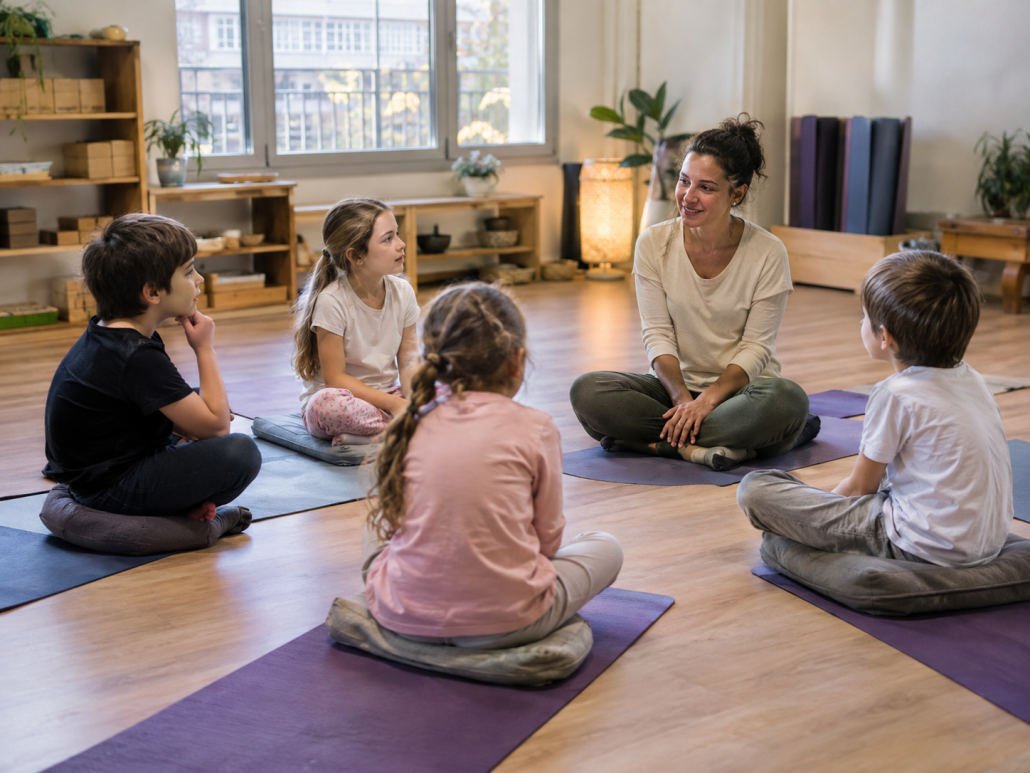
In the circle, the child does not encounter only the adult, but above all their peers. This dimension is particularly important because it allows them to see others not only as people with whom to compete, compare, or share activities, but as individuals who possess thoughts, emotions, fears, desires, and difficulties.
In the class group, this experience can help develop relational competencies that are difficult to learn solely through theoretical explanations. Waiting for one’s turn, listening to a voice different from one’s own, recognizing the value of what a peer is recounting, accepting a difference of opinion, or respecting someone else’s need for silence are all concrete forms of social learning.
The educational circle therefore allows one to live kindness, listening, and collaboration instead of merely talking about them. The child can understand what it means to be welcomed because they experience it, and precisely this experience can progressively help them offer the same kind of attention to others.
In this sense, Educational Yoga in the class group can become a true training ground for relationships, in which one learns that being together does not mean renouncing one’s individuality, but finding a way to exist alongside others without having to continuously defend or impose one’s space.
The Circle in Yoga at School
In yoga at school, the circle assumes particular significance because it enters an environment in which relational dynamics are already strongly structured. Every class possesses balances, friendships, conflicts, subgroups, more or less visible roles, and established modes of communication. The circle does not erase these dynamics, but can offer a different configuration of space and relationship.
When there are no desks separating, when no one occupies a frontal position, and when everyone can meet with their gaze, the way in which the group perceives itself also changes. The very form of the circle suggests a more horizontal relationship, in which each person can feel part of the experience without necessarily having to assume a central role.
This is particularly significant in yoga in primary school, where learning to be in a group is a fundamental part of development. But the same principle can be valuable also with older adolescents, especially in moments when a class is going through relational difficulties, changes, or situations of tension.
The circle in Educational Yoga at school is therefore not only the place in which to begin a practice, but can become an educational form capable of supporting listening, belonging, mutual respect, and awareness of relationships.
The Closing Circle: Transforming Experience into Awareness
If the opening circle prepares for the experience, the closing circle in Educational Yoga allows one to gather it and give it meaning. After movement, play, postures, breath, visualization, or relaxation, coming back together can help children and adolescents recognize what they have lived and connect bodily experience with their sensations.
There is no need to transform this moment into a test or an interrogation. On the contrary, a few open questions can be sufficient to stimulate attention and awareness: what did you like?, did you notice something different in your body?, what was the easiest or most difficult moment?, what do you want to take with you from this experience?
Questions of this kind do not seek a correct answer, but invite one to observe and recognize what has been lived. The child gradually learns to recognize what they are experiencing, while the adolescent can develop a greater capacity to listen to their own state without necessarily having to judge it.
In the closing circle, moreover, the group discovers that the same experience can be lived in different ways. Someone may have found an exercise relaxing that for another was difficult, while a game very engaging for some may have required more time to adapt for others. Recognizing that different experiences can coexist in the same space is already an important exercise in education for diversity and respect.
Circle and Emotional Education in Children
The circle in Educational Yoga can also become a significant space for emotional education for children and adolescents, provided it is not used to compel everyone to speak about their emotions.
Educating about emotions does not mean continuously asking “how do you feel?”, but creating conditions in which the child can gradually learn to recognize bodily signals, sensations, and inner states. Some children easily manage to use words, while others can express themselves better through a gesture, a movement, an image, or a simple choice among different possibilities.
Educational Yoga offers precisely this richness, because it allows one to connect emotions, body, and bodily awareness. The child can notice that agitation modifies the breath, that a stable posture produces a particular sensation, or that after a moment of intense movement the body needs to slow down.
The circle then becomes the place in which these observations can, if desired, be shared with the group. In this way, emotional education is not reduced to an explanation of emotions, but becomes concrete experience of listening, self-recognition, and relationship with others.
The Circle with Adolescents
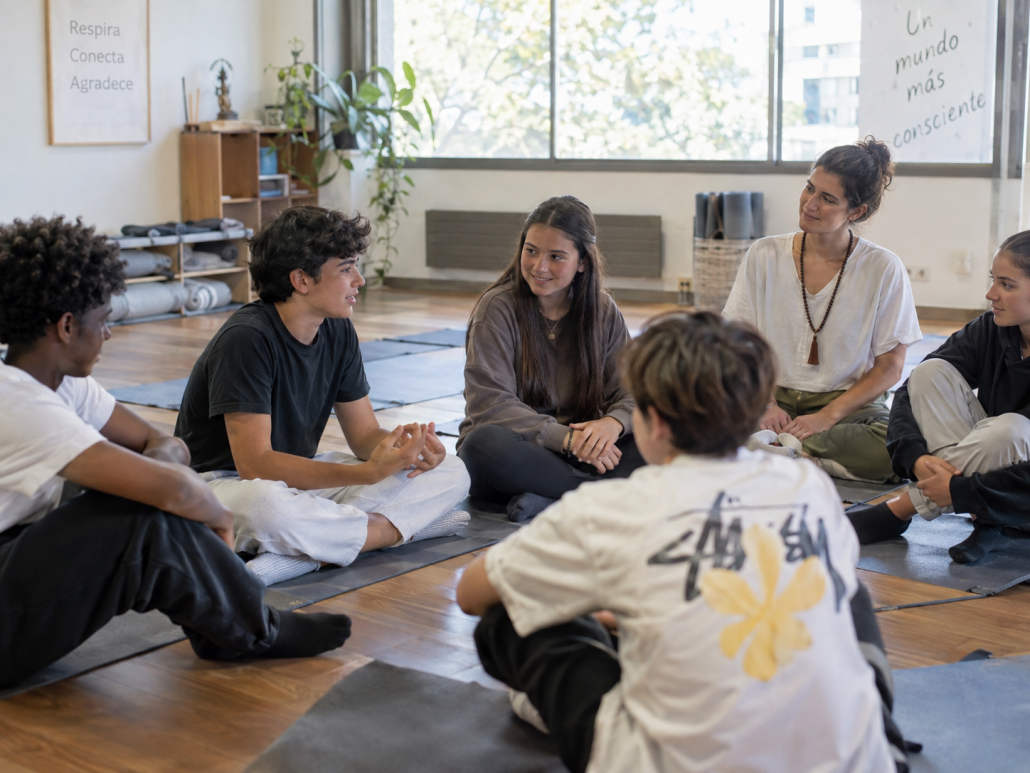
In work with yoga with adolescents, the circle requires particular sensitivity, because this phase of growth is strongly influenced by the need for belonging and the fear of judgment from peers. Not all adolescents immediately accept exposing themselves, and many forms of irony, withdrawal, or provocation can have a protective function.
Precisely for this reason, the circle in yoga for adolescents should not be used to compel confidences. Its strength lies rather in progressively creating a context in which it is possible to take one’s place in the group without having to play a role, to listen without feeling continuously called upon to respond, and to speak without the fear of being immediately evaluated.
For an adolescent, it can be very important to experience that their voice has value, but that it is not necessary to occupy all the space in order to be recognized. Similarly, they can discover that one can participate also through listening and that silence need not be interpreted as failure.
With adolescents, therefore, the circle can become a delicate form of education in presence, relationship, and authenticity, in which trust is not demanded immediately but built over time.
From the Circle to Daily Life
The value of the circle in Educational Yoga does not end when the practice finishes. The competencies that children and adolescents experience in that space can progressively transfer into daily life: listening before reacting, waiting for one’s turn, using words with greater attention, noticing the mood of others, and recognizing one’s own.
In this sense, the circle can become a small school of relationship. It does not teach only how to speak, but also how to listen; it does not valorize only individual presence, but also the capacity to leave space for others. It also helps one understand that being part of a group does not mean becoming all the same.
These competencies are central in yoga at school, but they also have value in friendships, in the family, in sports, and in all relational contexts in which children and adolescents construct their way of being with others.
The Circle as an Experience of Belonging
There is finally a particularly profound meaning in the very form of the circle. When a group arranges itself in this way, each person can physically recognize their own place and that of others. I am here, you are there, and together we construct this space.
For a child, feeling truly part of a group is not always taken for granted. Even within the same class, there can be moments in which one feels excluded, barely visible, different, or unable to find one’s place. The circle does not automatically eliminate these difficulties, but offers a concrete representation of belonging.
No one occupies the center, because the center belongs to the group. Each person contributes to the overall form, and if someone is missing, that form changes.
This image can become a simple yet powerful metaphor for what it means to belong to a community: to be part of something without losing one’s individuality.
In Conclusion
The circle in Educational Yoga is much more than an arrangement in space. It can become a space of listening, relationship, presence, emotional education, and belonging, capable of accompanying children and adolescents from dispersion toward greater awareness of themselves and others.
In the class group, the circle allows one to practice respect, listening, the capacity to wait, and recognition of differences. In the opening circle, it can help the adult understand the real condition of the group before proposing activities, while in the closing circle it can transform what has been lived in the body into an occasion for reflection and awareness.
With adolescents, it can offer a space in which words are not forced and silence can be respected; with younger children, it can become a place in which one learns concretely that being heard and listening to others are two aspects of the same relationship.
In a time when children and adolescents are often very connected but not always truly heard, continuously exposed but not necessarily seen, the circle in Educational Yoga for children and adolescents proposes something extremely simple and, precisely for this reason, precious: the possibility of pausing, recognizing oneself, listening to oneself, and sharing a space in which each person can feel that their presence matters.
From this experience can arise a more conscious and more human form of education, in which the child is not considered only for what they must learn, but also for what they are, what they feel, and the unique way in which they enter into relationship with others.
Get to know the authors!

A certified instructor of Oki do Yoga, with a master’s degree in “Yoga Studies” from the University of Venice, she is an adjunct lecturer of the advanced training course “Educational Yoga at School” at the University of Padua.
Co-Founder and President of Ssd “Educational Yoga.”

Holding a Ph.D. in Pedagogical, Educational and Training Sciences from the University of Padua. The doctoral thesis focused on the training of trainers in Educational Yoga.
Docent of the advanced training course “Yoga Educativo a scuola.” the Advanced Training Course at UniPd was conceived by the founders of Yoga Educativo, together with Director Prof. Luca Agostinetto.
Co-founder and vice president of Ssd “Educational Yoga.”
