
Home » Uncategorized » Educational Yoga at school: between body and relationship
At school, the body does not stop participating the moment a lesson begins. It is present in the way a child enters the classroom, occupies space, sits, breathes, moves, encounters a difficulty, seeks the attention of others, or tries to regain their own. It is present in the agitation before a test, in the struggle to stay seated for long periods, in the enthusiasm of a shared activity, and in the difficulty of finding one’s place within the group.
Educational Yoga at school starts precisely from this presence and from a fundamental question: how can we support children and teenagers in knowing themselves better, regulating their energy, and relating to others without separating body, mind, and emotions?
Educational Yoga proposes a path in which movement, breath, listening, play, asana, imagination, and relationship are not isolated activities, but experiences that gain meaning when they are connected with educational intentionality. The goal is not to achieve perfect postures, nor to transform a lively class into a constantly silent group. Rather, the aim is to create conditions in which everyone can perceive what is happening within themselves, recognize their limits, meet others with respect, and participate in the group more consciously.
Table of Contents
What is Educational Yoga?
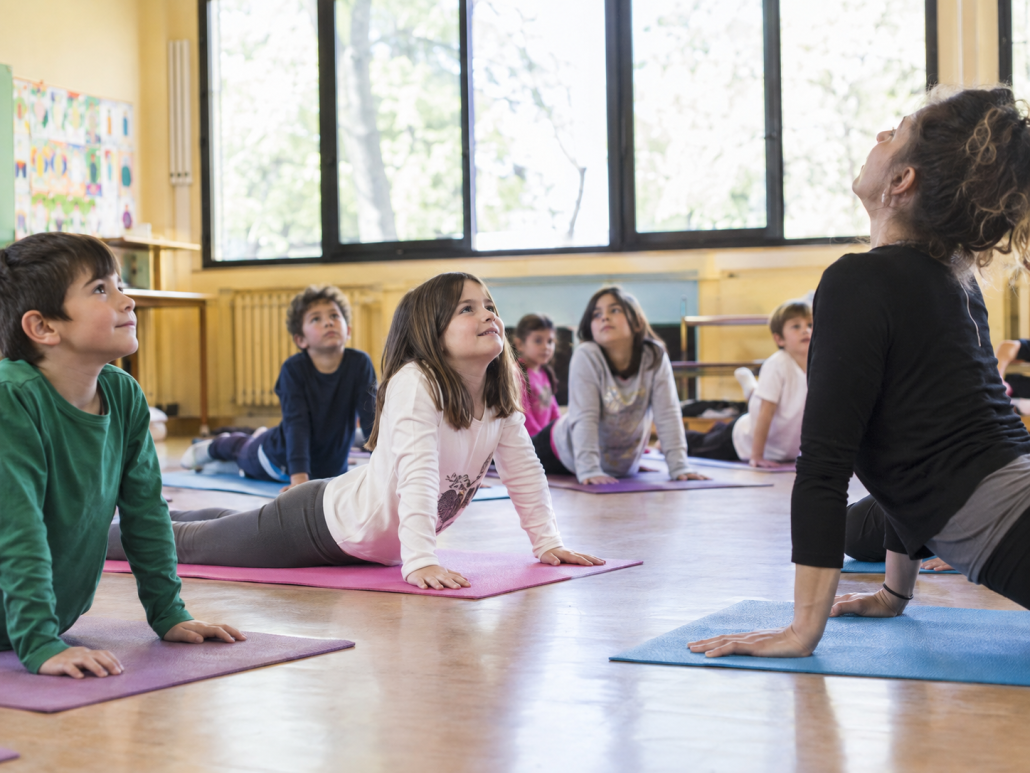
Educational Yoga is a method built to support children and teenagers in growth contexts. Its roots are yogic, but its educational identity stems from the meeting of multiple dimensions: school, pedagogy, psychomotricity, educational work, family experience, Meiso Shiatsu, and Action Research. It is not, therefore, a matter of taking a yoga lesson designed for adults and simply making it shorter or more playful.
A practice acquires educational value when the person proposing it knows why they are proposing it, observes how the group experiences it, and is willing to modify it when age, context, or the people present require something different. It is precisely this ability to connect purpose, experience, and observation that distinguishes an educational path from a simple succession of pleasant activities.
Educational Yoga considers the person in their entirety and connects dimensions that are often separated in daily life: gesture and thought, energy and stillness, individual experience and relationship with others.
Bringing Educational Yoga to school does not mean "doing adult yoga with children"
Children and teenagers have different rhythms, languages, needs, and forms of participation than adults. They need to move, play, imagine, try, choose, collaborate, encounter a rule, and also have moments in which to listen to what they feel.
For this reason, in yoga for children at school, movement is not simply the fun part that precedes the “serious” moment of practice. Running, changing direction, supporting one’s own weight, seeking balance, coordinating with a partner, or stopping after an intense activity are all experiences through which the child can know the qualities of their own body, encounter its limits, and learn to progressively modulate their energy.
Motor competence thus does not become a ranking of who is more flexible, stronger, or more capable. The body is not used to prove something to others, but as a tool for knowledge and experience.
Movement and stillness are not opposites
One of the central aspects of Educational Yoga at school is the relationship between movement and stillness.
Often, in educational language, movement is associated with agitation while staying still is interpreted as a synonym for attention. But a child does not automatically become more aware because they are ordered not to move.
Movement can instead be the necessary transition to reach a different quality of presence. After running, playing, or experiencing a physical sequence, the child can feel more clearly the beating heart, the changing breath, the heat of the body, tension, and subsequent recovery. In this way, even the breath stops being something to “do well” and becomes an experience to observe.
The primary skill is therefore not to immediately achieve calm or control, but to notice what is happening.
Breath as an experience of listening
The breath in Educational Yoga is also proposed from this perspective.
It is not a technique to be used automatically every time a child is agitated, and it is not a performance in which one must breathe deeper or slower than others. Instead, it can become a point of observation of the present condition.
After movement, for example, the breath may be faster. After a few minutes, it may change. The child can notice that the body is spontaneously returning to another condition.
This apparently simple experience can contribute to building an important ability over time: recognizing what happens before reacting automatically.
The Educational Yoga Wave: a rhythm between energy and listening
The internal structure of the method is called the Educational Yoga Wave. The image of the wave describes a flow that connects tension and relaxation, expansion and gathering, movement and stillness, dialogue with oneself and dialogue with others.
The experience does not proceed through a series of independent exercises, but through connected steps, capable of gradually supporting the group’s condition.
The Wave does not seek an imposed calm. Energy is first recognized, then it can find a form and progressively transform into attention, relationship, and listening.
However, this rhythm must not become a rigid scheme. A carefully prepared practice may encounter a class completely different from the one imagined: tired, highly activated, distracted, or worried. In these cases, the facilitator must be able to slow down, shorten, modify an instruction, propose a variant, or give up an activity.
Being faithful to the method does not mean always repeating the same lineup, but preserving its educational meaning while the forms change.
Why bring Educational Yoga to school?
School is one of the places where children and teenagers daily experience rules, relationships, movement, speech, attention, error, success, conflict, and collaboration.
In this context, Educational Yoga in schools can create a space in which to observe how one’s physical condition relates to learning and to others.
A balance lost and found can become an experience of limits and the possibility of trying again. A cooperative game can concretely show that personal success does not require putting someone else in difficulty. A pause can help perceive the difference between an immediate reaction and a more conscious response.
The educational value therefore does not lie in the single exercise, but in the meaning that experience can take on and in the possibility of recognizing it progressively even outside the practice.
Educational Yoga and the class group
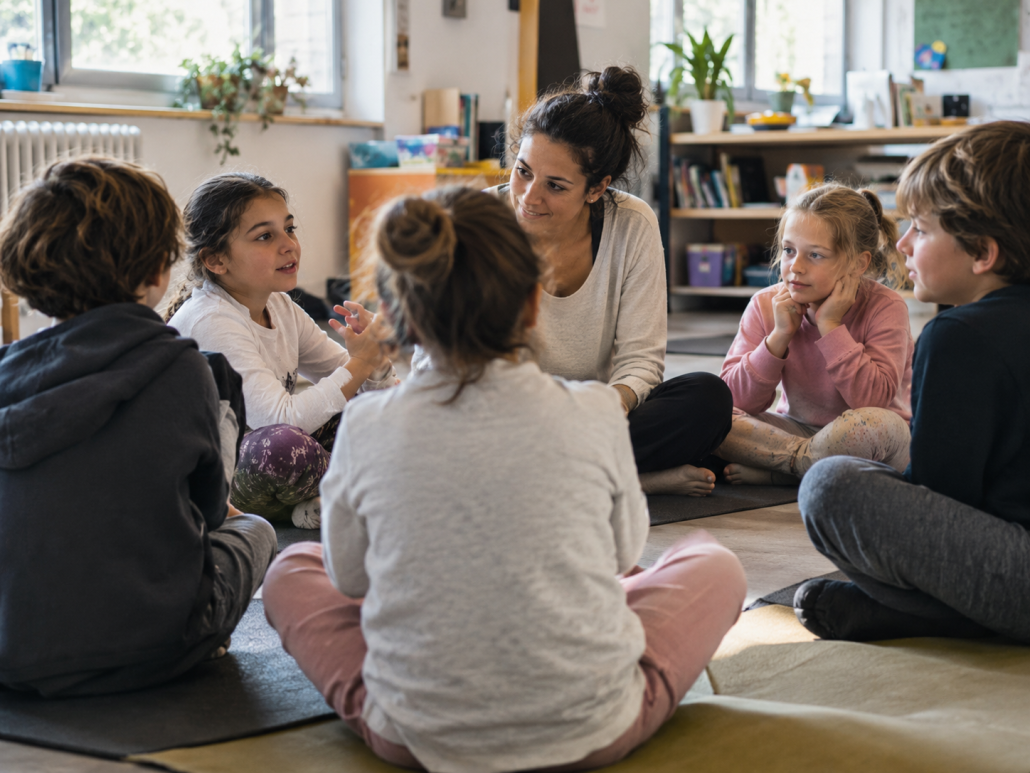
Educational Yoga at school is not just about the relationship with oneself. An important part of the experience also concerns the way we meet others.
Learning to be in a group means being able to recognize one’s own energy without invading that of others, participating without necessarily having to excel, collaborating, waiting, asking for help, and respecting a limit.
Through games, cooperative activities, circles, individual and pair experiences, the class group can become a place to concretely experience listening, respect, and mutual responsibility.
This does not mean expecting a yoga practice to automatically solve conflicts or relational difficulties. It means, rather, creating opportunities in which certain skills can be lived and observed.
Different ages require different practices
There is no single yoga session for children and teenagers valid from infancy to adolescence.
At five years old, an activity is experienced differently than at nine, twelve, or sixteen. The relationship with the body, the value attributed to the gaze of peers, the availability for symbolic play, the need for autonomy, and the meaning of physical proximity all change.
In early childhood, movement, imitation, and imagination can allow for an understanding that an abstract explanation would make more difficult. In primary school, the desire to succeed often increases, and it is important to guide this need toward the process, the attempt, and mutual responsibility. In pre-adolescence, the weight of the peer gaze grows, while in adolescence, authenticity, choice, and respect for autonomy become central.
Adapting a practice does not mean making it simpler or less significant. It means maintaining a common purpose while building different modes of participation.
Inclusion: not everyone has to do the same thing
A truly inclusive practice is not designed for an ideal child and modified only when someone fails to follow it.
In Educational Yoga and inclusion, the possibility of participating in different ways should be planned from the beginning. A child can perform a movement, use a variant, work near a partner, contribute with their voice, or observe for a while before entering the activity.
Observing does not necessarily mean rejecting.
For some children, it can be the way to learn the rhythm of the experience, feel safe, and subsequently decide whether to participate.
The same principle applies to limits and consent. One can choose a different distance, interrupt an activity, keep eyes open, or refuse contact without losing belonging to the group.
This idea is central: inclusion does not mean asking everyone for the same form, but allowing everyone to enter the same educational experience with dignity.
The presence of the adult is part of the practice
The quality of Educational Yoga also depends on the condition of the facilitator. Haste, fear of the unexpected, the need for control, the desire for everything to work as planned, and the search for approval inevitably influence voice, timing, instructions, and the quality of the relationship.
For this reason, training in Educational Yoga cannot be limited to teaching a repertoire of games, asanas, or breathing exercises. Personal practice, internship, observation, professional comparison, and a willingness to review what has been done are necessary.
Furthermore, the adult must not automatically interpret every gesture of the child. Observing does not mean diagnosing or attributing a hidden meaning to everything that happens. It is more respectful to describe what we see, verify the context, offer time, and listen to what the child eventually chooses to tell.
In this way, the adult presence supports without occupying the other’s inner space.
A method that grows through experience
Educational Yoga has also developed through continuous work of observation, comparison, and Action Research. In the documented path, 495 training reports were analyzed, used not as a simple collection of approvals, but as materials through which to observe difficulties, critical issues, and possible modifications to the method.
This aspect is important because it recalls a fundamental educational principle: what does not work can become a source of learning.
A critique can lead to modifying timing, instructions, space organization, or relationship modes. A practice that generates little involvement can force one to wonder if it is appropriate for the age or the group.
The method, therefore, does not automatically attribute positive effects to its activities. A moment of greater attention or a transition from agitation to listening are possibilities observed in a concrete situation, not proof that the same experience will always produce the same result. This caution is a form of educational responsibility.
From practice to daily life
When we talk about tools for life, we do not mean techniques to be applied automatically every time a difficulty arises.
Rather, we speak of abilities that can gradually appear even outside the practice: stopping before reacting, recognizing one’s condition, formulating a limit, going through an error without identifying with it, asking for help, choosing a response, and putting one’s own skill at the disposal of others.
The transition from practice to daily life cannot be taken for granted. It needs time, continuity, and collaboration between school, family, and educational figures.
The child, however, remains at the center as the subject of the experience and not as a simple recipient of decisions made by adults.
Bringing Educational Yoga into the school
Introducing Educational Yoga at school means building a project consistent with the age, context, and real characteristics of the group. It requires trained adults, capable of knowing the practice, planning clearly, observing without labeling, and modifying what they had prepared when the experience requires it.
The most important result is not a perfect position, nor is it achieving silence.
It is offering children and teenagers the possibility to progressively learn to read what is happening in their bodies, recognize and orient their energy, be in a relationship without losing themselves, and discover that movement and stillness can belong to the same path.
It is precisely in the meeting between body, relationship, and experience that Educational Yoga finds one of its deepest meanings in the school context.
Bottom line.
Bringing Educational Yoga to school means recognizing that learning does not occur only through words and content, but continuously involves body, emotions, energy, attention, and relationships.
The child who enters the classroom brings all of this with them. They do not leave their body outside the door and do not easily separate what they feel from what they think or what happens in relationships.
Educational Yoga then tries to create a place where these dimensions can meet intentionally: moving and stopping, experimenting and observing, encountering a limit and trying again, listening to oneself and being with others.
Not to build perfectly calm or perfectly flexible children, but to support growing people in developing greater self-knowledge, possibility of choice, and quality of relationship.
And this is perhaps precisely the educational question that remains at the center: how can we help children and teenagers to be fully in the school experience without having to leave a part of themselves outside?
To learn about the method and delve deeper into how to bring it into educational contexts, you can discover the Educational Yoga training paths dedicated to teachers, educators, and professionals working with children and teenagers.
Contact us, we will be happy to help you!
Are you interested in implementing an Educational Yoga project in your school or in your area?
Please do not hesitate to contact us to receive further information and discover how we can contribute to the well-being and development of your children and young people.
Send an email to the National Projects Coordinator [email protected]
or fill out the form to be contacted.
Do you want to become an Educational Yoga Instructor?
Contact us now to receive more information about our courses and get advance news about our initiatives!
Get to know the authors!

A certified instructor of Oki do Yoga, with a master’s degree in “Yoga Studies” from the University of Venice, she is an adjunct lecturer of the advanced training course “Educational Yoga at School” at the University of Padua.
Co-Founder and President of Ssd “Educational Yoga.”

Holding a Ph.D. in Pedagogical, Educational and Training Sciences from the University of Padua. The doctoral thesis focused on the training of trainers in Educational Yoga.
Docent of the advanced training course “Yoga Educativo a scuola.” the Advanced Training Course at UniPd was conceived by the founders of Yoga Educativo, together with Director Prof. Luca Agostinetto.
Co-founder and vice president of Ssd “Educational Yoga.”
