
Home » Uncategorized » Picture Books and Educational Yoga: When Stories Become Experience
Stories hold a special place in childhood. Through words and images, children and young people can enter unknown worlds, meet characters different from themselves, approach emotions that are difficult to express, and imagine possibilities that do not yet belong to their everyday experience. Picture books for children, in particular, possess a special richness: text and images dialogue, complement each other, and sometimes contradict one another, leaving the reader precious space to observe, interpret, and imagine.
When picture books meet Educational Yoga, the story can take a further step. What has been heard or observed can be experienced through the body, movement, breath, play, imagination, and relationship. A character can suggest a quality to explore, a journey can become a bodily experience, an image can accompany a visualization, and a narrative situation can open reflection on emotions or relationships.
In this way, children’s literature does not simply represent a pleasant introduction to practice, nor does it serve to “disguise” yoga to make it more interesting to children. If chosen and used with intentionality, the story can become a true guiding thread of the experience and offer Educational Yoga practice a narrative framework capable of connecting body, thought, emotions, and awareness.
Table of Contents
What is a picture book?
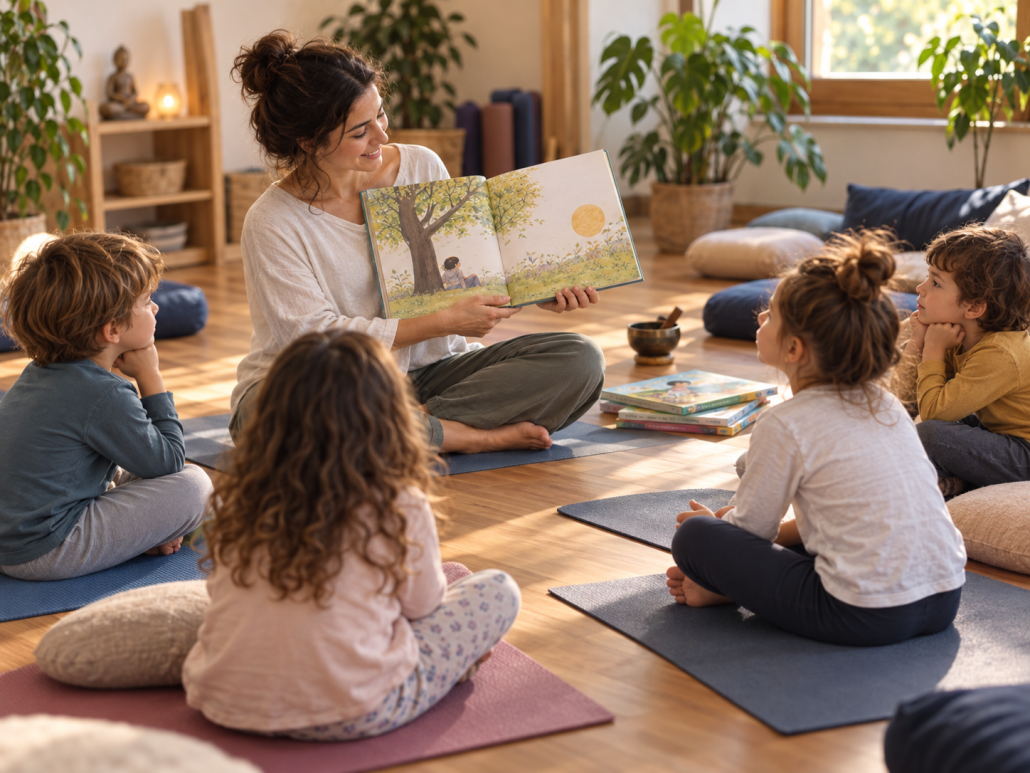
When we think of a children’s book, we might be led to imagine a simple text accompanied by a few pictures. The picture book is instead a much more complex language, in which words, images, narrative rhythm, page composition, colors, and even what is left unsaid all participate in the construction of meaning.
The image, in fact, does not only have the task of showing what the text tells. It can add information, suggest an emotion, anticipate what will happen, create a contrast, or leave an interpretation open. This is why a good picture book can be read multiple times and continue to offer new details, connections, and questions.
Children’s literature should therefore not be considered exclusively as a tool for conveying a lesson or moral. It can be a space in which to engage with different points of view, formulate hypotheses, imagine alternatives, and gradually construct one’s own thinking. The materials from which this exploration arises highlight precisely how a good book can offer educational possibilities that go beyond a simple didactic purpose.
This characteristic makes the picture book particularly interesting in Educational Yoga as well, because both languages can open an experience without necessarily needing to define it in advance in all its meanings.
Why are picture books important in childhood?
Reading or listening to a story means taking a small journey outside one’s usual experience. For a few minutes we can see the world through the eyes of a character, wonder what they will do, imagine what might happen, and compare their experience with our own.
This possibility of symbolically inhabiting different situations encourages the construction of hypotheses and openness to different points of view. Narration allows us to imagine alternative scenarios to everyday life and can stimulate reflection, understanding, empathy, and the ability to observe the same situation from different perspectives.
They stimulate imagination and thought
A story does not necessarily deliver all the answers. Often it is precisely its empty spaces that make it interesting: what is that character thinking? Why did they make that choice? What might happen on the next page? What is the image not telling us?
In these passages the child is not a passive recipient, but participates in the construction of the story. They imagine, connect, anticipate, interpret, and can formulate different solutions. The story thus becomes a space in which to exercise thought without the pressure of having to immediately find a correct answer.
They allow us to encounter emotions and different points of view
Stories also allow us to approach complex emotions through a protective distance. Before speaking about our own fear, our own insecurity, or the desire to be recognized, we can observe a character living through a similar situation and ask ourselves what they might be feeling.
Generosity, trust, courage, friendship, diversity, waiting, frustration, autonomy, need for help, and the ability to be together can emerge naturally from the plot, without necessarily being transformed into a “lesson on emotions.”
It is an important difference: the story does not explain the emotion, but allows us to encounter it.
They create a space for relationship and listening
Shared reading also has a relational dimension. Looking at an image together, waiting for the continuation of a story, listening to others’ observations, and discovering that the same page can evoke different interpretations means learning that there is not always only one way of seeing what happens.
This openness to the other’s point of view is particularly interesting in Educational Yoga, where listening does not only concern oneself, but also the way one enters into relationship with the group and with the experience being shared.
How to use stories and picture books in an educational pathway?
Using a picture book in an educational activity does not necessarily mean reading it from beginning to end and then asking “what does this story teach us?” A reading too oriented toward a predetermined moral risks reducing the richness of the story and guiding everyone toward the same conclusion.
A story can instead become a starting point. We can pause on an image, anticipate what might happen, observe a character’s posture, imagine their thoughts, or let certain words return later in a game or bodily activity.
The book can accompany the experience without having to dominate it. There are practices in which the narration can be present throughout the entire journey and others in which an image, a situation, or a question is sufficient. The fundamental element is that between story and activity there exists a coherence of meaning, avoiding using the picture book simply as a pretext for proposing exercises already decided in advance.
From this point of view, one of the most effective images that emerged from the study materials is that of the picture book as a compass: the narration can orient the different phases of the Wave of Educational Yoga, while images and characters can suggest movements, positions, and possibilities for experience.
Picture books in Educational Yoga
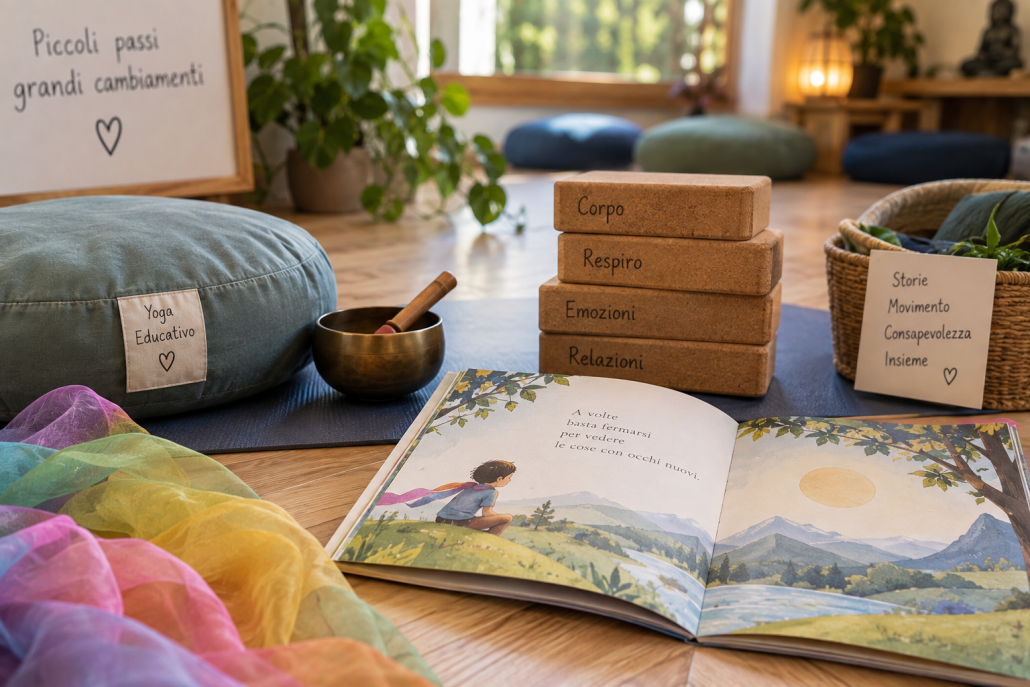
Educational Yoga simultaneously engages body, movement, breath, play, imagination, relationship, and listening. The picture book possesses a similar quality, because it brings together words, images, emotions, thoughts, and possibilities.
The meeting between these two languages can therefore happen very naturally. The story offers a symbolic framework within which to move, while Educational Yoga allows what has been imagined to be transformed into a concrete and bodily experience.
In pathways developed from picture books, this passage clearly emerges: after the reading, the body enters the story through its multiple possibilities of expression and what was contained in the pages can become movement.
This does not mean, however, literally representing every element of the story. The most interesting possibilities open up when we seek to understand which qualities run through the story: stability, lightness, trust, energy, waiting, fear, openness, collaboration, courage, curiosity. It is these qualities that can become the material of practice.
From narration to movement
Imagine a story that tells of a journey. One could simply mime the characters’ walking, but one could also explore something deeper: the enthusiasm of departure, the uncertainty before what we do not know, fatigue, the need to stop, the encounter with someone, the desire to set off again.
At this point the body is no longer illustrating the story, but is exploring some of its qualities.
Movement can be large or small, fast or slow, decisive or hesitant. One can experiment with balance, the passage from activation to stillness, moving individually or together with others. It is precisely in this passage that the story can become an experience and not remain only something we have heard.
Images, asana, and bodily play
The illustrations can also offer many stimuli. Does a character’s body appear open or closed? Does it seem light or heavy? Is it stable or does it seem about to lose balance? What does its posture communicate?
Observations of this kind allow us to move from image to body without necessarily having to create a literal association between each figure and a yoga position.
Naturally asana can enter the practice and some images can spontaneously suggest them. A tree, an animal, or an element of nature can become an immediate starting point. However, in a practice of yoga for children, what matters is not only “doing the right position,” but exploring how we feel while assuming it, what changes when we seek stability, when we expand the space of the body, or when we find balance.
In this way the asana remains connected to the story but also acquires a dimension of listening.
Breath, relaxation, and visualization
A story has a rhythm: there are moments of action and moments of waiting, accelerations, pauses, and passages in which it seems almost necessary to stop.
The Wave of Educational Yoga also moves through different qualities, alternating activation and relaxation. The story can therefore offer particularly effective images to accompany the passage toward breath, stillness, or visualization.
A wind that calms, a leaf descending slowly, a safe place reached after a journey, a changing sky, or a character who finally stops can become images capable of sustaining attention without the need for lengthy explanations.
Narration and mental images thus allow us to build a bridge between children’s stories, imagination, and bodily awareness.
Stories as a space to encounter emotions
One of the most interesting aspects of using picture books in yoga for children concerns precisely the possibility of exploring emotions without necessarily making them the object of a theoretical explanation.
If the protagonist is afraid, we can observe how we imagine their body: is it rigid? Does it make itself small? Might the breath be fast? If they subsequently find courage, what might change? Does the body open? Does the movement become more decisive?
Through the character we can approach an experience and, through practice, we can explore how certain qualities are perceived in the body.
It is not necessary to arrive at the conclusion “fear is this” or “to be brave we must do this.” It is much more interesting to let each person find their own way of recognizing what they are experiencing.
The value of questions
In the meeting between Educational Yoga and picture books, questions can play a very important role both during reading and in designing the activity.
An open question does not serve to verify whether the child has correctly understood the book. It can instead stimulate curiosity and inquiry: what do you think might happen? What might this character be feeling? What does this image make you think? Is there another way of seeing the situation?
Those who design the practice can also use questions as a tool for awareness: why did I choose this particular picture book? What experience do I wish to make possible? Am I using the book only as a backdrop or do the activities truly dialogue with the story? Which images or themes can return in the different phases of the Wave?
In the materials analyzed, asking questions is indicated precisely as a tool for designing, focusing attention, and not settling for the first available solution.
The question, therefore, does not necessarily have to lead to an answer. It can simply set something in motion.
How to choose a picture book for an Educational Yoga practice?
Not all picture books for children need to become the starting point for a practice, just as it is not necessary to choose exclusively books that explicitly speak about yoga, meditation, or emotions.
Often the most interesting stories are those capable of leaving space. A narration about a journey can simultaneously speak of curiosity, fear, change, and relationships; a story about uniqueness can open reflections on diversity, comparison, and self-esteem; a story about friendship can also contain solitude, trust, conflict, and the ability to ask for help.
Before proposing a book it can therefore be useful to read it several times and know its images, rhythm, and possibilities well. It is important to ask which theme truly emerges, which parts have the greatest evocative power, how much time the reading requires, and in what way it can dialogue with the various phases of the experience.
Conscious design does not consist in knowing in advance what each child must understand. Rather, it means clarifying the adult’s intention and preparing a structure solid enough to then be able to listen to what happens during practice. In the study materials, precisely the reasoned choice of the book, knowledge of its timing, and the way to present it are considered an integral part of designing the Wave.
Sometimes, in fact, a story leads the practice in a different direction from the one imagined. And it is precisely here that observation and adaptability become important: the outline offers a foundation, but must not prevent welcoming questions, reactions, intuitions, and needs that emerge in the group.
Bottom line.
Picture books and Educational Yoga share an important characteristic: both can open a space of experience in which not everything must be immediately explained.
Stories allow us to imagine, encounter emotions, assume different points of view, and formulate questions. Educational Yoga adds the language of body, breath, movement, listening, and relationship. When these elements are brought into dialogue with intentionality, a story can become the thread that accompanies the Wave and gives meaning to the different experiences.
It is not therefore a matter of transforming every picture book into a yoga lesson, nor of using children’s literature to convey a moral established in advance. Rather, it is about recognizing that some stories possess images, rhythms, themes, and questions capable of continuing even outside the page.
Perhaps, then, before asking ourselves “what activities can I build around this book?”, we can pause for a moment and ask ourselves another question:
“What might this story become if it were also lived through the body?”
It is from here that an image can transform into movement, a word into breath, a story into reflection, and a picture book into a small journey of awareness.
If you wish to explore tools and methodologies for offering Educational Yoga to children and young people, discover our training pathways and the Educational Yoga method.
Contact us, we will be happy to help you!
Are you interested in implementing an Educational Yoga project in your school or in your area?
Please do not hesitate to contact us to receive further information and discover how we can contribute to the well-being and development of your children and young people.
Send an email to the National Projects Coordinator [email protected]
or fill out the form to be contacted.
Do you want to become an Educational Yoga Instructor?
Contact us now to receive more information about our courses and get advance news about our initiatives!
Get to know the authors!

A certified instructor of Oki do Yoga, with a master’s degree in “Yoga Studies” from the University of Venice, she is an adjunct lecturer of the advanced training course “Educational Yoga at School” at the University of Padua.
Co-Founder and President of Ssd “Educational Yoga.”

Holding a Ph.D. in Pedagogical, Educational and Training Sciences from the University of Padua. The doctoral thesis focused on the training of trainers in Educational Yoga.
Docent of the advanced training course “Yoga Educativo a scuola.” the Advanced Training Course at UniPd was conceived by the founders of Yoga Educativo, together with Director Prof. Luca Agostinetto.
Co-founder and vice president of Ssd “Educational Yoga.”
